
Hancock County’s Current Owner Record
The Current Owner field sits in the state assessment result for a Hancock County parcel. Each row joins that name to the Property Address, county and district, map and parcel, deeded acres, class codes, and building, land and total appraisal. A GIS Map link and a Flood Tool may appear too. The record card is rich. Still, roll fields do not state every claim to title. Use the card to identify the parcel, then read the instrument that transferred it.
| Current Owner | Name carried on the assessment roll. |
|---|---|
| Property Address | Situs address assigned to the parcel. |
| Mailing Address | Correspondence address, which can be elsewhere. |
| Parcel identifiers | County, district, map, parcel and subparcel keys. |
| Deed Book / Page | Advanced search field for cross-reference to the clerk. |
| Appraisal | Building, land and total values on the result. |
An owner of record is not always the occupant. The mailing address may point to an out-of-county owner. It may also point to an estate, an attorney or a company manager. Treat the name as a record attribute, not a statement about who is home. It is also no reason to publish anyone's location. The legal description keeps the lookup tied to the land. The parcel key keeps it tied there too, rather than to a personal-name match.
Hancock County’s Assessment Result
The WV Property Assessment search handles Hancock County parcels through several query modes. You can search by Owner Name, Street Name, Full Parcel ID, or Map Number. Parcel and Sub-Parcel queries work as well. Advanced options add Mailing Address, Legal Description, Deed Book and Page. Building year, structures, and flood hazard appear too. A result also links to the Property Viewer. Keep the limits in mind. This is a roll search rather than a verified deed extract. Open the Hancock County owner and parcel search interface.
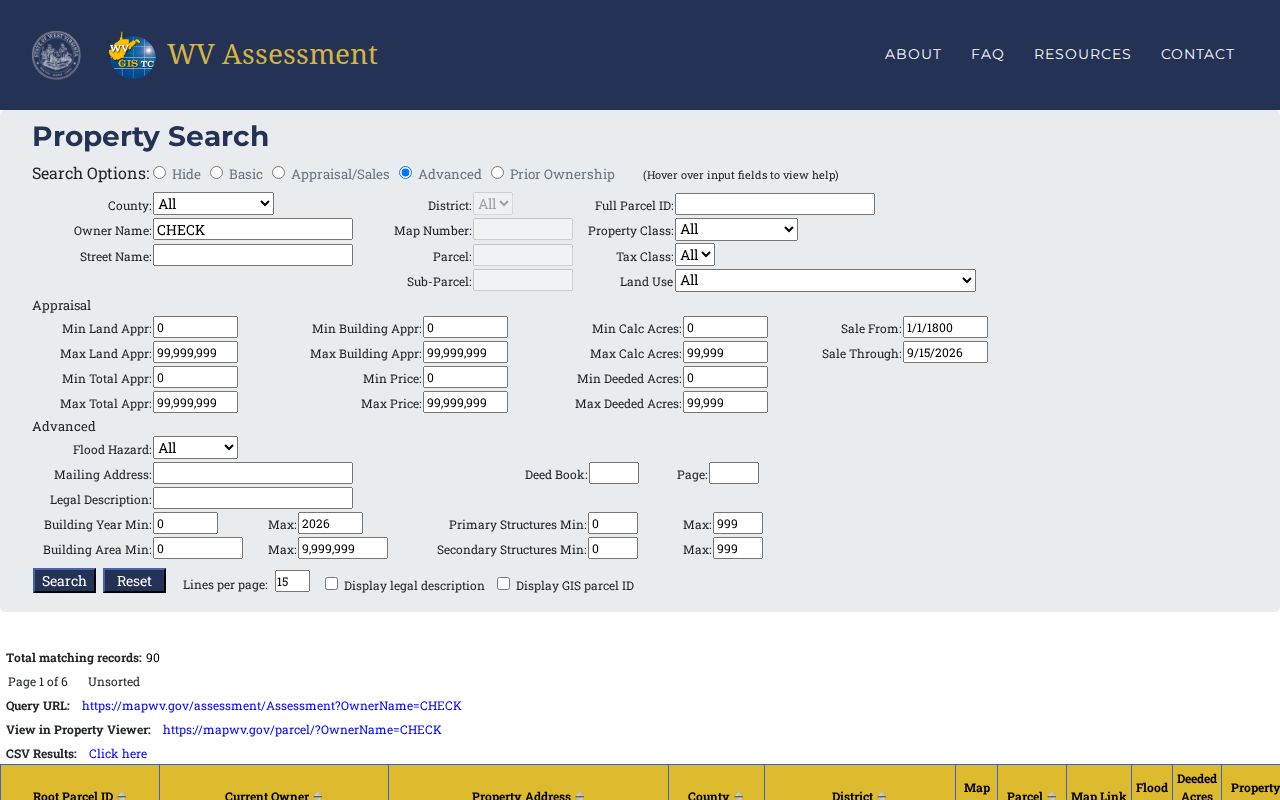
Run the live query before trusting any name. The search page lists its modes and filters; only a live result shows the owner attached to a specific parcel.
Confirming the Hancock County Owner Today
Set the roll name beside the newest recorded conveyance. If they differ, look at the recording date and the legal description first. One entry may simply be older. The county's public materials give no fixed number of days for a closing to reach the assessment system. Assume no standard update lag.
- Read the Current Owner field and save the parcel’s full identifiers.
- Use the deed book/page or party name to find the newest conveyance in CCLIX.
- Compare the grantee and the deed’s legal description with the assessment result.
- If an estate or business appears, identify the party role from the recorded instrument.
- Owner of record
- The name displayed by the assessor for the parcel.
- Grantee
- The recipient named in a recorded deed.
- Legal description
- The written land identity that should match the parcel.
Hancock County Roll and Deed Timing
The assessor keeps an administrative roll, updated through county and state assessment work. A deed can be indexed before the roll shows the new owner. That gap is common after a sale. The county publishes no typical transfer-to-roll interval. When timing matters, the recording date on the latest deed is the direct evidence of what was filed. Check the assessment result again later for the roll's current entry.
New parcel lines run on their own clock. The state warns that newly created or split parcels wait for county submission and the annual state update. A new deed may beat the map change. Keep the older parcel ID and the new legal description together while the new entry is pending. That pairing prevents confusion during the gap.
Hancock County Situs and Mailing Address
Situs means where the land lies. The mailing address directs tax correspondence instead. It may be a home office, attorney, trust, estate or management address. Both fields are searchable in the assessment interface, which helps when mail goes elsewhere. Neither proves occupancy. A postal city label also fails to prove municipal boundaries in Hancock's narrow corridor.
Match the owner name to the parcel key and legal description. Do not rely on the address on a letter. A company owner may list an administrative address. The registered agent is only a business-contact role. The deed's grantee remains the land-record party.
Hancock County Entity and Estate Names
The name may be an LLC, trust or estate. The roll carries whatever name the county uses for valuation. The deed shows who received the property. It also explains how title is vested. Probate adds its own twists. The County Clerk records wills and probate papers, yet a will alone may not change the land record. Look instead for an executor or fiduciary deed, heir deed, partition, sale order or deed from heirs. Match the document to the estate history.
For a business entity, a West Virginia Secretary of State filing can confirm status and registered agent. It does not replace the recorded deed. Keeping the entity's exact spelling, parcel and deed reference together avoids mistaking a similarly named person or company for the owner of record.
Monitoring a Hancock County Filing
Doc Alert is the County Clerk's email alert service. It sends a notice whenever a deed or mortgage is recorded under a chosen person's or business's name. An alert signals a new filing, nothing more. It cannot remove a public record or determine fraud. It also cannot confirm the document concerns a particular parcel. Open the instrument itself and compare the legal description, the parties, and the recording reference before you act on any notice.
Inspection at the clerk's office is free. Online images take an assigned account and access fees instead. If an alert arrives, quote the clerk's official number when asking how to inspect the filing, and never trust an unsolicited letter or a bare name match.
Using Hancock County Owner Details Lawfully
Use owner details for real property questions only. A boundary concern or a purchase due-diligence request fits that purpose, and notes or copies should stay limited to what the task requires. The assessment roll is not a personal profile. An owner field does not show who lives in the home or how to approach a resident. Public status has limits. A record can be public while privacy and safety still constrain how it gets used.
Lawful use. Hancock County ownership data supports property research and due diligence. Do not use a name or address to stalk, threaten or harass anyone.
Check a Current Roll Entry Against the Deed
Begin with the Assessor's owner-name or parcel search. Note the full parcel identifier. The current owner, property address, district, and legal description belong in your notes too. The roll shows a current assessment view. The recorded deed names the instrument that actually transferred an interest. Check both systems after a recent purchase, inheritance, or business transfer. The Hancock assessment roll does not state how quickly it updates after recording, so confirm any difference with each office rather than blaming an assumed delay.
Next, search the County Clerk's index. Use the current owner's name as grantee. Add the prior owner as grantor when known. Before deciding a document matches the parcel, review its date and full legal description, because a shared surname alone is weak evidence when an owner holds multiple lots or has a common name. A book and page number helps the Clerk locate a record image. An instrument number or approximate date works too. Include whichever you have in a request to the Clerk.
Tax records sit in a separate system. The Sheriff portal uses its own account and year-specific ticket fields. A taxpayer's name or a paid ticket can confirm which account to review. A tax bill still does not prove a conveyance. Only the deed serves as evidence of transfer. One owner may carry several tickets or parcel components, so carry the district-map-parcel-subparcel key through the search and verify that the ticket's year and property type match your question.
Keep the title holder apart from the mailing contact. The occupant is a third category again. Assessor output separates the owner and property address from a mailing destination, and some titles sit with entities or estates. For legal assurance, obtain a complete title examination. Public indexes can locate a recorded transfer, yet they cannot establish that no other interest, lien, or later document affects the land.