
Finding a Hancock County Property Owner
Start with the address. West Virginia's assessment search lets you enter a situs address. It then pulls the matching Hancock County roll entry. Save the identifiers it returns: root parcel ID, district, map, parcel, and subparcel. Then read the Current Owner field. Compare that name and the land description. Do this before trusting the entry fully. Check them against the most recent deed in the Hancock County Clerk index. That comparison tells you who sits on the tax roll today. It also shows who actually took title in the recorded deed. Tax records and map records play supporting roles.
Working from just a name is harder. Search the assessment roll for the person or entity. Then test each likely result against the property address and parcel identifiers. A name can repeat across tracts. It can arrive through an estate or trust, or hide behind a business entity. A shared name alone never proves that someone owns a particular parcel.
- Search the address or owner in the WV Property Assessment portal.
- Copy the parcel key, situs, mailing address and Current Owner field.
- Use the latest clerk deed reference to confirm the grantee and legal description.
- Check the sheriff portal only for tax ticket status, not as proof of title.
- If the grantee is an entity, check the relevant West Virginia business filing for its registered-agent role.
Hancock County’s Assessor Owner Field
The assessment result labels its name column Current Owner. Around it sit other fields. These include Property Address, county and district, map and parcel, and a GIS Map link. More fields list deeded acres, property class, land-use code, tax class, and building, land, and total appraisal. Remember what the row is. It is a tax roll entry naming the county's present administrative owner. A closing recorded yesterday may not appear yet.
The search page offers several modes. These include Street Name, Owner Name, Full Parcel ID, Map Number, Parcel, and Sub-Parcel. It also accepts a mailing address or legal description. It can filter by deed book and page. The search form itself is not a parcel card. Treat it only as the route in. Then open the live result and check its parcel and deed fields before drawing any conclusion about an owner of record.
Open the West Virginia assessment search used for Hancock County properties.
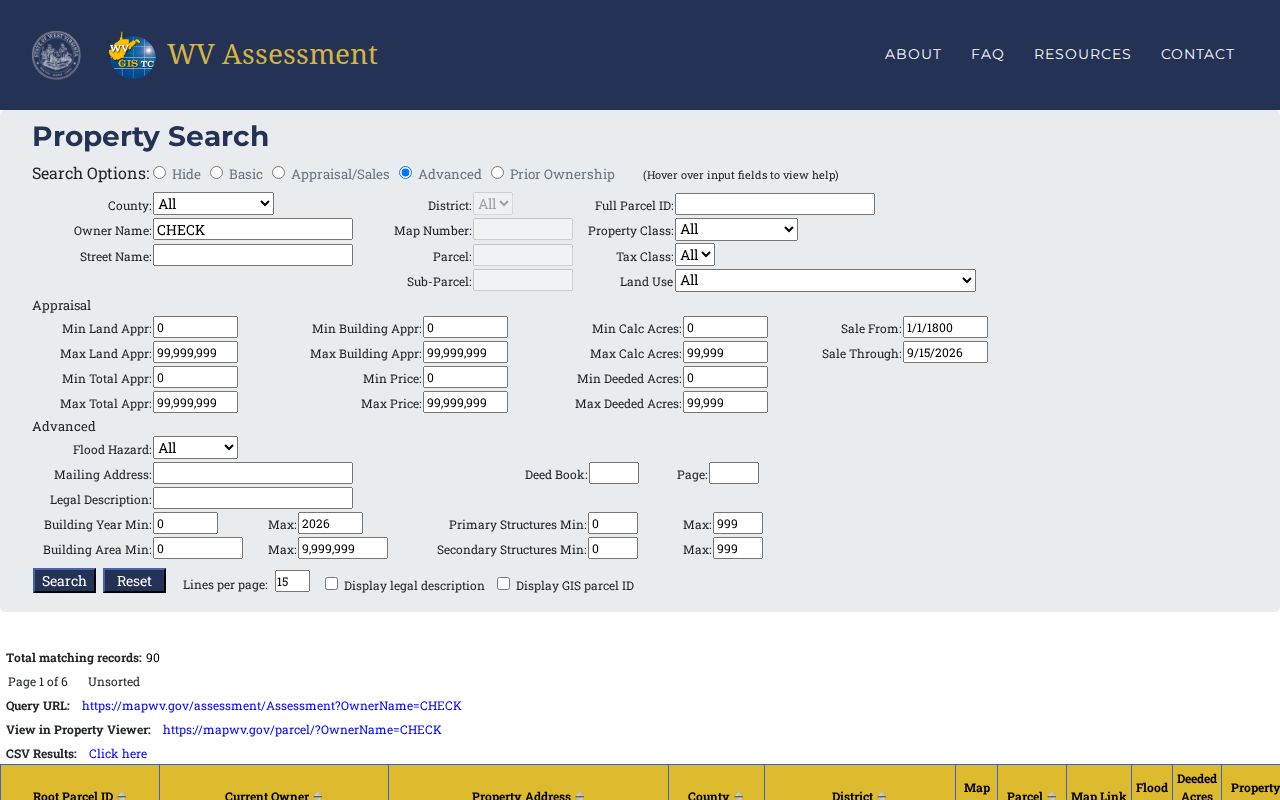
The live result row is what ties an owner name to its parcel key. The search page only shows the route; it proves nothing about a specific owner.
Hancock County Ownership Sources
Hancock County ownership facts live in two offices, and they answer different questions. The assessor's roll names the administrative owner for assessment. The clerk's deed names the parties to a recorded transfer and describes the land itself. GIS can help you locate the parcel. The sheriff's tax portal can pin down a ticket. A court file may explain a dispute or an estate event. A complaint, though, stays an allegation until the court resolves it.
Where Hancock County Owner Records Meet
| Source | Owner Info It Gives | Access |
|---|---|---|
| Assessor roll | Current Owner field, situs and mailing address. | Free WV Property Assessment search. |
| County Clerk deed index | Recorded grantor, grantee and instrument reference. | Public counter; online CCLIX account and image fees. |
| WV Property Viewer | Mapped parcel location and linked identifiers. | Free statewide viewer. |
| Sheriff tax portal | Taxpayer, ticket and payment status. | Online search and payment route. |
A public record names an owner or grantee. It does not name whoever happens to be inside the house on any given day. The situs address fixes the parcel's location. The mailing address shows where the county sends tax bills and notices. For a vacant lot, an LLC holding, an estate, or an owner who lives out of state, those two addresses may not match at all. Treat these fields as tools for property research. Do not treat them as a personal-contact dossier on a person.
Recent Hancock County Sales and Roll Timing
A newly recorded deed can land in the clerk's index first. The assessor may not change the owner field yet. Hancock's public pages promise no fixed closing-to-roll delay. So skip the day counting. For a recent transaction, open the clerk index. Check the filing date and the deed reference. Then compare that instrument's grantee and legal description against the current roll result.
The state page warns of a second lag. Newly split parcel lines wait for county submission and the annual state update. So one record looks new while another looks old. Keep the deed, the root parcel ID, and the roll result together. If a mismatch persists, contact the custodian who holds that record. Do not assume one portal controls every field.
Hancock County LLC, Trust and Estate Owners
An LLC, trust, or estate can show up as the owner of record on a parcel. The assessor records the name as filed. Names get tricky at this point. The County Clerk holds wills and probate papers. A death transfer may involve an executor's deed, an administrator's deed, an affidavit of heirship, a partition, or a deed from heirs. The probate file proves the estate was administered, yet the key real-property record remains the land instrument or court order in the deed chain.
An LLC's registered agent is not the landowner. A business filing only names a service contact. Use the entity's legal name as a search clue, then read the deed's vesting language and legal description. Estates need the same care. Separate the decedent, the fiduciary, and the heirs, because each name can fill a different role as the parcel moves through probate and later conveyance.
- Grantee
- The recipient named in a recorded transfer.
- Vesting
- The way a deed states the recipient’s ownership interest.
- Owner of record
- The name carried by the assessor roll.
- Situs and mailing address
- Property location and correspondence destination, which may not match.
Confirming a Hancock County Owner
The last recorded deed is your proof point. Pull it before calling any name search final. The Hancock County clerk keeps a deed index running back to 1979. Most images dated January 2004 onward are viewable online. Anything older usually means a trip to the office or a microfilm reader. Search by party name and a date window. Then hold the deed reference and legal description up against the assessor parcel. Every field must agree. Remember that an index line is not the document itself. The public pages show no sample CCLIX row.
When the name and map key refuse to line up, look for the usual culprits: a parent parcel that split, an estate transfer, an entity holding title, or a renamed street. Working the deed chain settles mismatches that name searching alone never will. For a fuller route through Hancock County property records, the Hancock County deed-records page lays out the clerk's access options and coverage.
Limits of a Hancock County Owner Lookup
Know what an owner lookup cannot tell you. It does not prove who lives in a building, that every interest got recorded, or that a title is marketable. The tax roll can lag behind a fresh deed. A listed name may belong to a company or an estate rather than a person. A map polygon is only a reference, so settle boundaries with survey evidence. Public status also grants no license to republish sensitive details. It grants no license to use records to threaten anyone.
Lawful use. Use Hancock County owner records for property research, due diligence and civic purposes. Do not use names or addresses to stalk, threaten or harass a person.
Match the Owner Name to the Parcel
A name hit is a lead. Treat it that way. The state assessment search can return several parcels for one person or entity. Compare each result's property address, county, district, map and parcel details, current-owner line, and mailing address. The mailing address often differs from the situs. Use it to tell records apart, not as a stand-in for where the land sits. Keep the full parcel ID handy. The same tract can then be traced through the tax and GIS tools.
Missing a familiar name? Search last name first. Drop the middle initial, or enter a business name exactly as the record spells it. The assessed owner may be an LLC, a trust, an estate, or a co-owner group. It may not be the person living in the home. A current tax account can also sit under a taxpayer name. That name may not match the latest recorded grantee. One spelling variation never proves someone owns nothing in Hancock County.
To verify a recent transfer, carry the assessor result into the County Clerk's deed index. Hunt the recorded instrument under the grantor and grantee names. The assessor's roll and the clerk's land records serve different purposes. They rarely reflect changes at the same moment. Read the deed image itself, or ask the clerk about the filing. A Doc Alert can tell a subscriber when a deed or mortgage lands under a name. Still, it is no title search and makes no judgment about fraudulent filings.
Owner data serves legitimate property research and due diligence. Skip the temptation to copy names and addresses into unrelated lists. Never contact an owner in a harassing way. A public listing is not consent to be contacted. Private details are rarely needed to understand a parcel anyway. If an entry looks sensitive or wrong, take the correction or redaction question to the office holding that record.