
What Hancock County Deed Records Contain
The Hancock County Clerk records more than deeds. The deed carries the conveyance language and land description. An assessor owner field, by contrast, is only an index to the current tax roll. The clerk's public page names the wider family of instruments, including mortgages, mechanics liens, tax liens, releases, assignments, powers of attorney, wills and plats. Estate transfers often involve an executor or heirs. So the party names and the authority stated in the actual document matter.
| Deed Type | What It Does | Common Use |
|---|---|---|
| Conveyance deed | Records a transfer of a real-property interest. | Confirm the grantor, grantee and legal description. |
| Executor or fiduciary deed | May carry an estate-authorized transfer. | Read the authority and probate context. |
| Heir deed or transfer | Can document property passing from heirs. | Compare with the estate file and prior deed. |
| Deed after a sale | May follow a sheriff or tax-sale proceeding. | Check the court or sheriff confirmation too. |
| Mortgage release | Records release of a mortgage lien, not a new owner. | Match it to the original instrument. |
A deed is not a mortgage. The first records a conveyance. The second records an encumbrance that may need its own release. The table groups instrument types named in the county's records material rather than the full CCLIX dropdown list. No sample row appears on the public landing page.
Hancock County’s CCLIX Coverage Dates
The clerk's Legal Records page gives separate coverage dates. CCLIX deed indexing reaches back to 1979. Mortgage indexing reaches back to 1971. Most instrument images are online from January 2004 to the present. The County Clerk reports that county records began in the early 1850s, so 2004 is not the start of anything. The clerk's CCLIX access page explains the online route and options for older records. Its coverage note explains a common search result. An index hit can appear with no downloadable image. That occurs before the online image run. The name, instrument type, recording date and document reference help staff find the record in older books or microfilm. See the Hancock County Clerk's Legal Records page for CCLIX access information.
That distinction matters when you research an old transfer. If the index date predates the online image run, continue the search at the counter with the reference in hand.
Searching Hancock County Party Names
The public CCLIX landing page hides its full form. The index itself is organized around party names. Document type, recording date and an image or document reference round out the fields. Search a grantor or grantee under the name form used on the deed. Narrow common names by date or instrument. If a known transfer still misses, try initials, punctuation-free text or an entity name.
| Index clue | How it helps | What to confirm |
|---|---|---|
| Grantor / grantee | Follows who transferred or received an interest. | Role and name as written on the deed. |
| Instrument type | Separates deeds from mortgages, liens and releases. | Use the clerk’s coverage list; options are not fully public. |
| Recording date | Narrows repeated names and transfer periods. | Filing date is not always the closing date. |
| Book/page or document number | Identifies the filed instrument for follow-up. | Carry it to the image, book or microfilm. |
The clerk, not the public page, describes these fields. An unauthenticated visit shows only part of the form. The complete search screen and a sample indexed row sit behind an assigned CCLIX account.
Following Hancock County Grantors and Grantees
A grantor transfers an interest. A grantee receives it. The County Clerk's name index can be read forward or backward, but the real goal is identifying the recorded instrument and its parties. The chain of title links earlier owners to a present parcel. Cross-check with the assessor's legal description and parcel key. That matters most when a current street address does not appear in an older deed.
- Start with the likely current grantee and locate the latest conveyance.
- Read the grantor, description and reference on that instrument.
- Search the prior party as a grantee to find the deed by which that party acquired the land.
- Compare descriptions as you move back; an estate, sale, split or name change may alter the path.
- Use books and microfilm when the chain predates the online index or image coverage.
- Grantor
- The party who conveys an interest in the instrument.
- Grantee
- The party who receives that interest.
- Chain of title
- The ordered record of conveyances for the land.
- Book and page
- A volume-and-page reference used to locate a recorded document.
- Instrument number
- A document identifier; use the exact reference displayed by the index.
A search result is only a finding aid. Read the full deed. The legal description, referenced plats, restrictions and parties all live in the document, and the index will not say whether a recorded interest was later released or whether an unrecorded claim exists.
Older Hancock County Deed Books
Hancock County's land records run past the online years. County records date to the early 1850s. The clerk directs researchers to office inspection or microfilm for anything older than the online run. FamilySearch's catalog and the West Virginia Division of Culture and History are other possible routes. Neither source promises a complete digital year run of Hancock deed or plat books.
Work from the document reference and legal description, not the address alone. Older volumes describe land differently. A historic deed may locate a tract by streams, roads, monuments or another parcel. The current street name may not have existed yet. If a description covers only part of a larger holding, note the calls plus any subdivision or survey reference before picking the next index entry.
The 1850s records are a beginning point. They do not prove every older book is online. Nothing does. For a gap, ask the clerk which deed book, index or microfilm reel covers your date and instrument type.
Hancock County Counter Access and Fees
Viewing records at the counter costs nothing. The clerk lets the public browse the deed indices and record books in the office for free. Online document images work differently. They call for an account and password from the website administrator, special software, and access fees. Copy pricing is posted too: $1.50 for the first two pages of a deed or document, then $1.00 for each page after that. Fees can change, so confirm the current schedule before mailing a request.
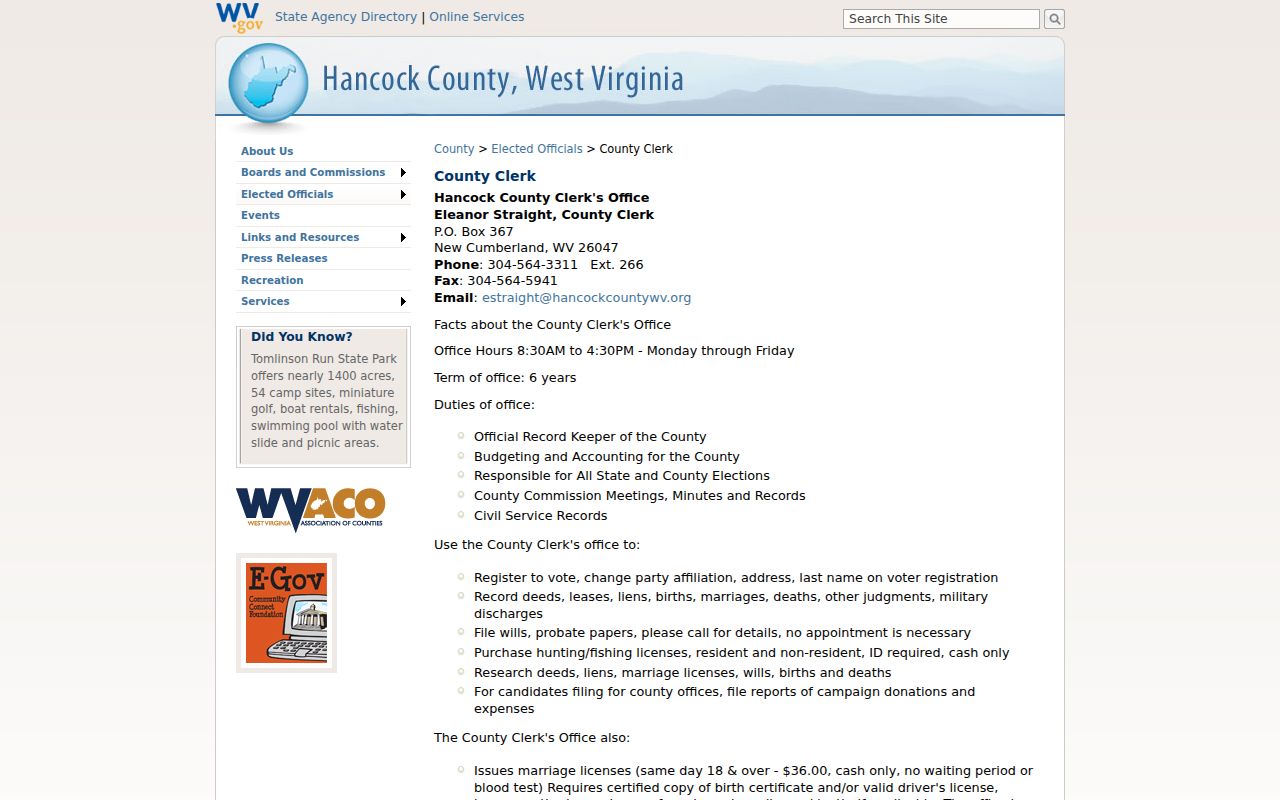
The County Clerk’s office page gives the New Cumberland counter details and contact route. Bring cash or a money order for ordinary county requests. Personal checks are not accepted, though corporate, business, and attorney checks are fine. The clerk sits at PO Box 367, New Cumberland, WV 26047, open weekdays from 8:30 a.m. to 4:30 p.m., with phone 304-564-3311, extension 266. Check the clerk’s page for current copy instructions before you go.
A counter visit can bridge an older index entry to its paper or microfilm image when the online file is unavailable. Staff can pull what the digital record will not open.
Hancock County Doc Alert Notices
Doc Alert is the clerk's email notice service. It sends word when a deed or mortgage is filed. You choose the person's or business's name it watches. An owner of record can use it to watch for new filings on the parcel. It is not a title search. It does not detect fraud. Nor does it stop a document from entering the public record. If an entry looks wrong, read the filed instrument. Then contact the clerk through its official number.
The alert never replaces the clerk's index, public counter, or microfilm. That goes for older filings. It also goes for images the online account cannot open. Keep the name spelling, date range, and parcel description together. A notice may concern a different person with a similar name. Always confirm the document's legal description before drawing any conclusion.
Requesting a Hancock County Deed Copy
Once the index gives a reference, the full deed comes through the assigned online account. It also comes through the County Clerk's office. Counter inspection is free. Copies cost $1.50 for the first two pages of a document. Each page after that adds $1.00. The county posts no mail-order form for deed copies. Call the clerk before mailing money or relying on an old fee schedule.
Include the instrument type, party names, recording date, and book and page or document number in the request. Say whether the copy should be plain or certified. Ask which payment method applies. Do not send a personal check for an ordinary county request. The posted instructions name cash or money order. Corporate, business, or attorney checks work as well. A certified copy serves a different purpose than a quick online image.
Recorded, not guaranteed. The deed index shows documents filed with the clerk; it is not a title opinion. A complete title review may need related releases, liens, plats and court orders.
Prepare a Useful Deed Copy Request
Narrow requests are easiest for the Clerk to route. Name the grantor and grantee. Add the approximate recording date. Include the deed book and page or instrument number when known, plus the property location or legal description. For a release, point to the mortgage or vendor's lien being released. A blanket request for every deed under a common surname can sweep in many unrelated parcels. Start from a current assessor result or a known deed reference and work backward instead.
Know what you need before asking. Inspecting an index at the counter is free. Copies carry a page charge. The first two pages of a document cost $1.50, and each additional page is $1. Cash or money order covers ordinary requests. Corporate, business, and attorney checks are fine too, but personal checks are not. Confirm current handling details with the Clerk before mailing payment or making the trip.
Recording staff sit at the courthouse in New Cumberland. They answer through the main county number at extensions 279 through 281. Records reach back to the early 1850s. Online date ranges vary by index and image type, though. Give staff the date range and instrument kind so they can advise whether CCLIX, an in-office book, or microfilm is the practical next step.